EMR software for doctors in India.
A plain-language guide.
What an EMR actually is, what it costs, how it compares to paper for a small clinic, and what to look for before you commit to one. Only after that — what EMRDoctor does.
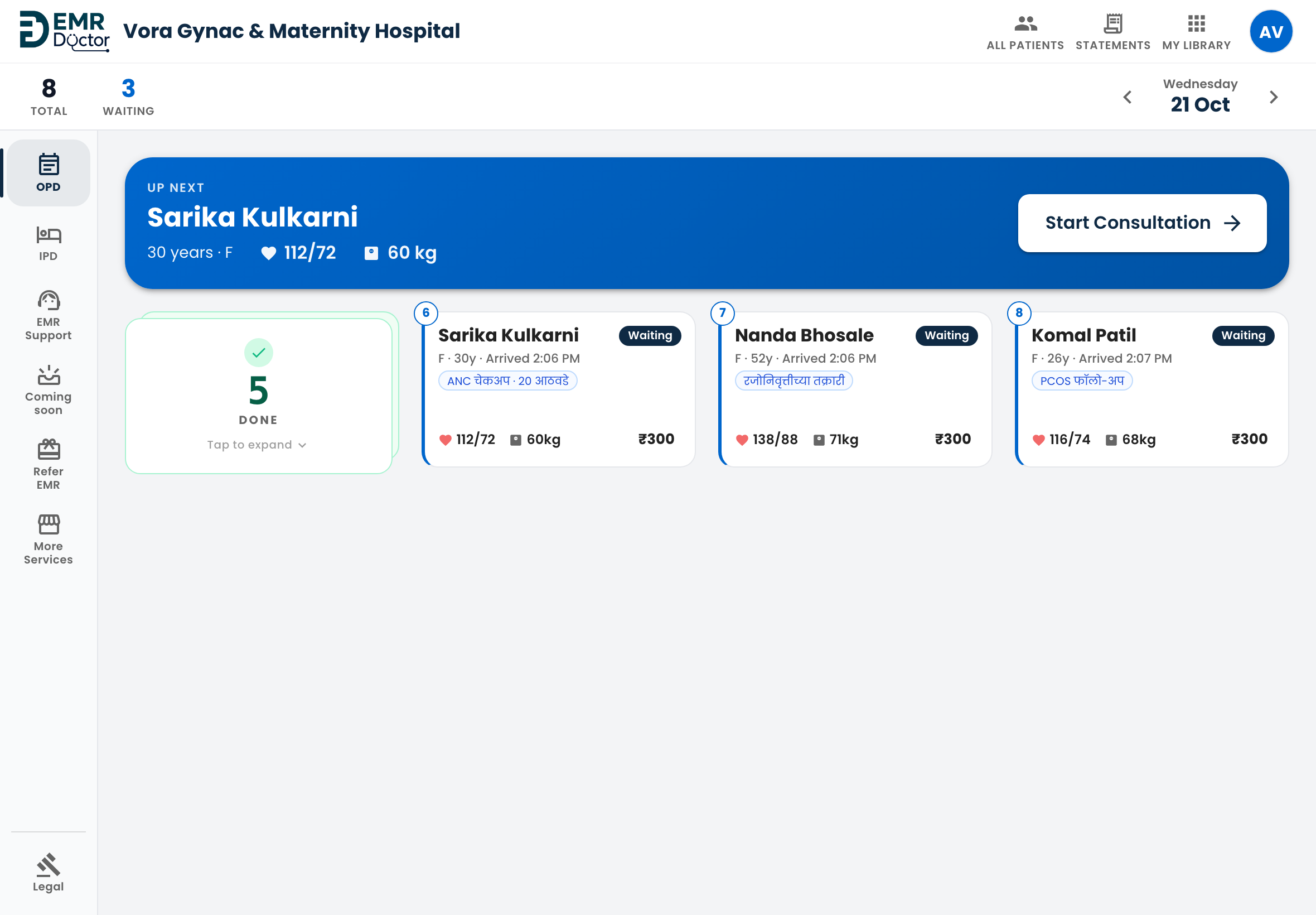
An EMR is the software a doctor uses during the consult.
“EMR” stands for Electronic Medical Record. It is the software a doctor opens on the iPad or laptop duringthe consultation to see a patient’s past visits, write the prescription, and keep every visit on one record. In a hospital it also runs the queue, admission, nursing round, discharge and billing — all on top of the same patient record.
Two words that get used interchangeably but shouldn’t be:
- EMR — the record of what happens inside your clinic or hospital.
- EHR(Electronic Health Record) — a longitudinal record of a patient that different clinics can see. ABDM (Ayushman Bharat Digital Mission) is India’s EHR layer. EMRDoctor plans ABDM integration for Q1 2027; the EMR itself is live today.
For a solo doctor, an EMR replaces the paper file + the handwritten prescription slip. For a hospital, it replaces the paper admission form, the drug chart, the discharge letter, the handover register, and the IPD + OPD reception book — and connects them to one patient record underneath.
Monthly wallet, no contract, free until your team is trained.
Public pricing ranges widely in India. The honest shape of the market:
- Monthly, prepaid wallet — pay as you use. No annual lock-in, no large upfront. If you stop paying, billing stops. This is the shape EMRDoctor uses.
- Annual licence — usually priced a little cheaper per month if you commit for a year. The catch: migrating out mid-year is expensive, and if your clinic grows past the licensed seats you re-negotiate instead of just adding one.
- Per-prescription or per-patient — convenient for a slow-growing clinic; expensive once you hit three-figure daily OPD. Model-dependent.
What marketing material rarely tells you upfront: training and migrationare often charged separately, and the cost can match the first year’s subscription. Ask every vendor you shortlist for a line-item quote that includes both. EMRDoctor is free until your team is trained and migrates your existing patient register free, within a working week; the exact monthly number is on the demo call.
Where paper still wins. Where it stops.
A good paper register, filled in diligently by one doctor + one receptionist, is better than a badly-chosen EMR. Honest comparison:
Paper wins when
- Internet is unreliable and your patients are mostly new (no history to look up).
- Your consult is 2 – 3 minutes and the prescription is a short script you can write by hand.
- You do not need to share the record with anyone outside the clinic.
Paper stops working when
- A returning patient walks in and the right file isn’t findable in under a minute. This is the single biggest tell.
- You add a second doctor, or a nurse, or an admin, and the handovers go through notes on scraps of paper.
- You start running an IPD. Nursing drug charts on paper + OPD on paper mean the same patient carries two parallel records and the discharge summary gets copied by hand.
- A patient family asks you to WhatsApp the prescription, or the pharmacy wants a clearer dose than your handwriting.
- Your city turns the lights off on paper (a tax audit, a legal case, an insurance dispute) and the paper file isn’t enough.
The switch pays off at the moment one of those lines becomes a weekly annoyance instead of a monthly one. Everyone we’ve onboarded says the same: they should have moved six months earlier than they did.
A short checklist you can take to any demo.
Ten minutes of each demo should answer these:
- Print the prescription in your patient’s language.Marathi, Hindi, Tamil, Bengali — the language your actual patients speak. If the vendor’s print is English-only or has broken rendering, that’s your answer. Dose errors drop sharply when the patient’s family can read the sheet on WhatsApp.
- Use it on an iPad.Not a demo laptop. The real consult surface is a tablet on a desk. If the vendor can’t get a 5-step consult done on an iPad in under a minute, their touch targets and layout aren’t designed for the room you’ll use it in.
- IPD on the same record.Even if you don’t admit today — ask what the IPD flow looks like. If it’s a separate module, you’ll re-type the admission chart from the OPD visit; if it’s the same record, you won’t.
- Full data export, on demand, free. Patient list, visit history, prescriptions, invoices, reports. Ask how fast, in what format, and whether there’s a per-record charge. Lock-in by export fee is still common in Indian EMRs.
- Support in your language, with a human. Doctors call support when the consult is already running late. Ticket portals and chatbots are the wrong shape of help in that moment. WhatsApp with a human reply within an hour on working days is a real different product category.
- Honest security claims.If a vendor says “ISO certified” without saying whichISO or showing the certificate, that’s a flag. If they say “HIPAA compliant” and they sell to Indian clinics, that’s another flag — HIPAA is a US framework. Ask for a specific written claim; we published ours on/security.
What EMRDoctor does.
EMRDoctor is an EMR built for the OPD day in India. Live OPD queue the reception runs, 5-step consult from chief complaint to signed prescription (58-second median across the live OPDs today), Marathi + Hindi + English prescriptions, maternity IPD on the same ledger. It runs on the iPad you already own.
We don’t ship separate OPD and IPD modules. A doctor who sees the patient in OPD opens the IPD chart on the same record, and the discharge summary shows up on the next OPD follow-up. Reception, doctor, nurse and admin each get a role-scoped view onto one patient record underneath.
For the detail that matters to your specialty, read the pages below. For how we keep your patients’ data safe — the honest version, including what we don’t claim yet — see/security.
Common questions about EMR software in India
What is EMR software, in one line?
Do I need an EMR for a 20 – 50 patients-per-day clinic?
What does an EMR cost in India?
What if my internet goes down mid-consult?
Is a digital prescription legally valid in India?
Can the prescription print in Marathi or Hindi?
Do I need an EMR that handles IPD too?
How long does it take to switch?
Read next
A demo is the fastest way to answer the one question you still have.
30 minutes on an iPad or screen share. We walk through the queue, a real 5-step consult, a Marathi prescription and the migration flow — and anything else you need to know before you commit.